We get this question a lot. A homeowner wants to add a garage workshop, a hot tub, an EV charger, or an ADU, and suddenly the conversation turns to electrical panels. Two terms come up: main panel and subpanel. People nod along, but they're not always sure what either one actually does.
So let's clear it up.
Your Main Electrical Panel: The Heart of the System
Every home has a main electrical panel. You probably know it as the breaker box. It's the gray metal box mounted on your wall, usually in the garage, utility room, or on an exterior wall.
This is where power from the utility company enters your home and gets divided into individual circuits. Each breaker in that box protects one circuit in your home. When something goes wrong on that circuit, the breaker trips and cuts power before anything gets damaged or someone gets hurt.
That last part matters. The breaker panel is not just a convenience feature. It is a safety system. A properly sized, properly wired panel protects your family and your home.
Most homes in Pleasanton and the Tri-Valley were built with 100-amp or 200-amp main panels. Older homes sometimes have 60-amp service, which was fine decades ago but falls short today. Air conditioning, EV chargers, heat pumps, home offices, and modern appliances all draw more power than homes were originally designed to handle.
When your main panel is undersized or outdated, the answer is a panel upgrade.
Subpanels: Extending Power Where You Need It
A subpanel is a secondary breaker box that gets its power from your main panel. It does not connect directly to the utility. Instead, a dedicated circuit from your main panel feeds the subpanel, and the subpanel then distributes power to a specific area of your property.
If your main panel is the hub, a subpanel is a spoke.
We install subpanels all the time for Tri-Valley homeowners who are:
Adding power to a detached garage or workshop
Running circuits to an ADU or guest house
Adding EV charging in a garage that sits far from the main panel
Finishing a basement or building a large addition
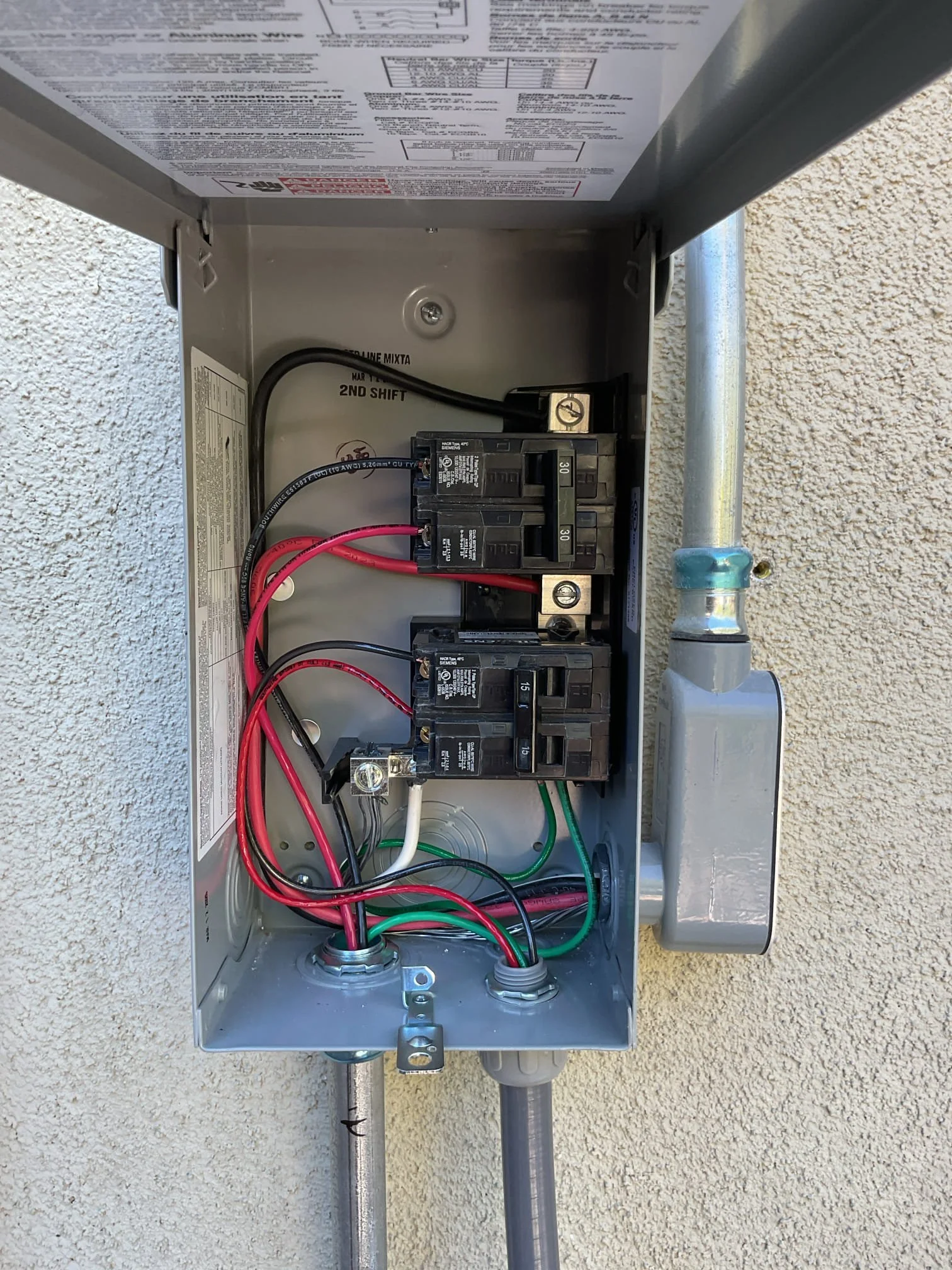
Recently, we installed an outdoor subpanel for a homeowner in Pleasanton who needed dedicated circuits for a new sauna and an AC unit. Rather than pulling long individual runs back to the main panel, we fed a subpanel on the exterior wall and ran clean, code-compliant circuits from there. Efficient, safe, and built to last.
The Core Differences
Your main panel is the source. Your subpanel is an extension. Here is how they compare:
Main Panel
Connects directly to utility power, controls the entire home, contains a master shutoff breaker, and is typically located inside or on an exterior wall of the main structure.
Subpanel
Fed by the main panel, controls a specific zone or structure, has its own disconnect, and can be located anywhere on your property.
One thing worth knowing: you can only install a subpanel if your main panel has the spare capacity to support it. If your main panel is already maxed out, a subpanel does not solve the problem. That is one of the first things we check.
So Which One Does Your Project Need?
Here is a straightforward way to think about it.
You likely need a subpanel if your main panel has capacity to spare and you are adding power to a specific area, a detached structure, or a new outdoor living space.
You likely need a main panel upgrade if your existing panel is old or undersized, breakers are tripping regularly, you are planning a major home expansion, or you are adding high-draw equipment like solar, battery storage, or a whole-home EV setup.
When in doubt, get an assessment before you commit to anything. The right answer depends on your current setup, and there is no substitute for having a licensed electrician take a look.
A Word on Safety
Electrical panels are not a DIY project. They are not a "good enough for now" project either. An improperly wired or overloaded panel is a fire hazard, and we see the results of shortcuts more often than we would like.
When Chase Electric installs or upgrades a panel, we do it to code, we pull the permits, and we make sure the work will hold up for decades. That is how we have operated in this community for over 30 years, and it is not something we compromise on.
We Know the Tri-Valley. We Know Your Home.
Whether you need a subpanel for a new garage circuit or a full main panel upgrade, Chase Electric will give you a straight answer and a fair quote. No upsells, no runaround.
Serving Pleasanton, Dublin, Livermore, San Ramon, Danville, Walnut Creek, and the surrounding East Bay.
Licensed C-10 Electrical Contractor. Family-owned and serving the Tri-Valley for over 30 years.
Frequently Asked Questions
How do I know if I need a subpanel or a full main panel upgrade?
It comes down to capacity. If your main panel has room to spare, a subpanel is often the right move for powering a garage, ADU, or outdoor space. If your main panel is already full, outdated, or undersized for your home's current demands, an upgrade is the safer long-term solution. A licensed electrician can assess your panel and give you a clear answer in one visit.
Is it safe to add a subpanel to my home?
Yes, when it is installed correctly and to code. A subpanel is a standard, code-compliant way to extend power to a specific area of your property. The key word is correctly. Improper wiring or overloading a panel are leading causes of residential electrical fires. Always use a licensed C-10 electrician and make sure permits are pulled.
Do I need a permit to install a subpanel in California?
Yes. Any new panel installation or significant electrical work in California requires a permit and inspection. This protects you, your home, and your insurance coverage. Chase Electric handles permitting as part of every job. No shortcuts.
Can I add a subpanel to a detached garage or backyard structure?
Absolutely, and it is one of the most common reasons homeowners call us. A subpanel in a detached garage gives you dedicated circuits for lighting, outlets, EV charging, power tools, and more without overloading your main panel. It is a clean, code-compliant solution built to handle real-world use.
How long does a subpanel installation take?
Most subpanel installs are completed in a single day. The timeline depends on where the subpanel is going, how far it is from the main panel, and how the existing wiring is set up. We will give you a realistic timeframe before we start, not after.